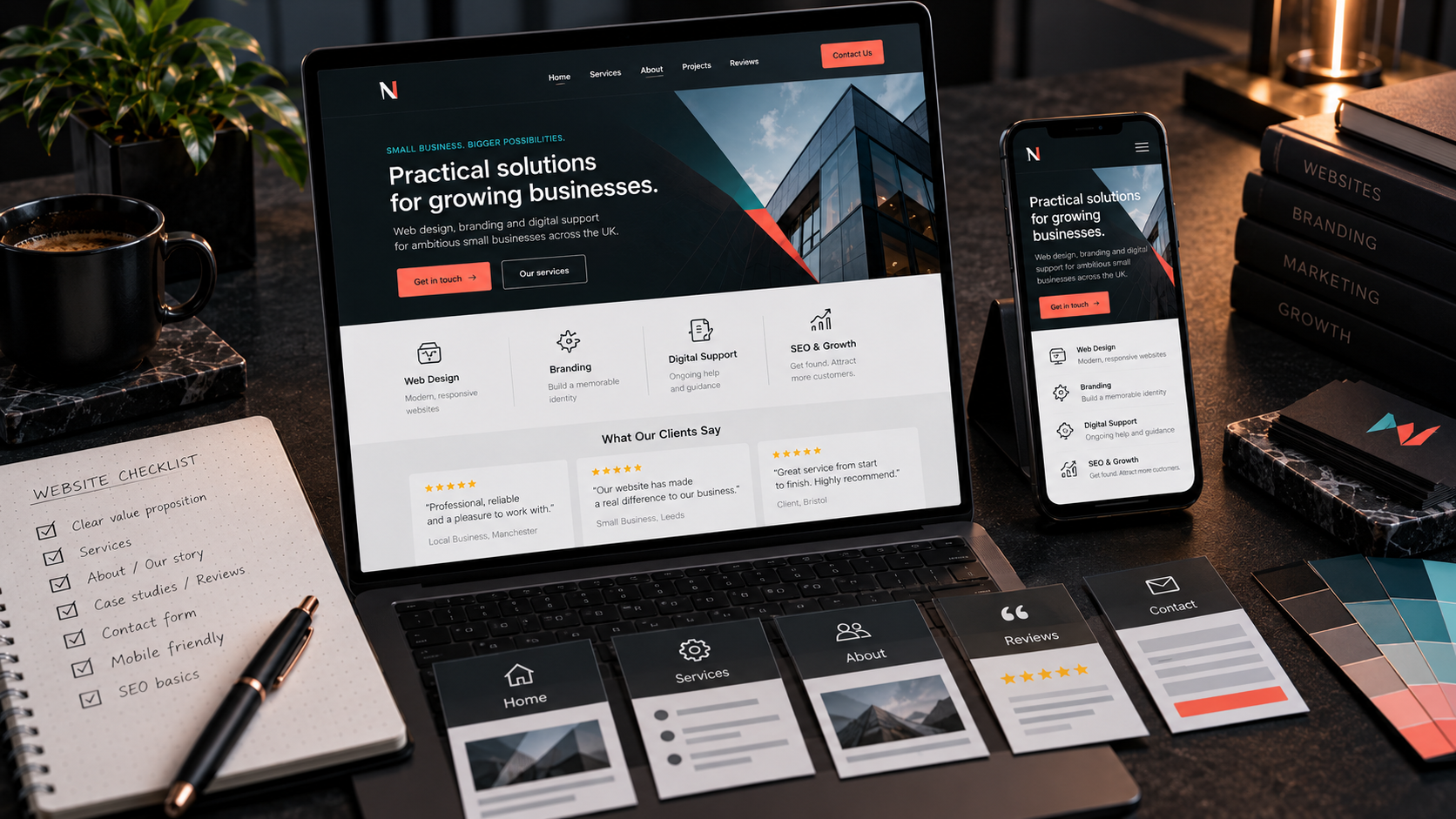
A small business website should help a potential customer do three things quickly: understand what you offer, decide whether they trust your business and know what to do next.
That usually requires a clear homepage, dedicated information about your main services, genuine proof of your work, straightforward contact options, a professional mobile experience and the technical foundations required for search engines to understand the website.
The exact number of pages or features depends on the business.
A local service company, restaurant, consultant and online shop do not need identical websites. What matters is whether the website answers the questions a potential customer needs answered before they call, enquire, book or buy.
A Small Business Website Has Three Main Jobs
Before deciding how many pages or features you need, it helps to understand what the website is supposed to achieve.
At Magic Three, we look at business websites through three connected principles.
Clarity
A visitor should quickly understand what your business does, who it helps and why they should continue exploring the website.
Unclear slogans, complicated navigation or pages filled with generic marketing language create unnecessary friction.
Credibility
Your website needs to give people enough confidence to consider your business seriously.
Professional design helps, but credibility also comes from clear information, genuine work, testimonials, business details, consistent branding and evidence that the company actually delivers what it promises.
Conversion
Once somebody understands and trusts the business, the next action should be obvious.
That might mean requesting a quote, calling, booking an appointment, making a purchase or submitting an enquiry.
A website can look excellent and still perform poorly if visitors cannot work out what they are expected to do next.
1. A Homepage That Explains the Business Clearly
Your homepage should answer the most important questions quickly.
What does the company do?
Who is the service for?
Where does the business operate?
What makes the company relevant to this visitor?
What should they do next?
You do not need to explain the entire business within the first screen, but visitors should understand enough to know they are in the right place.
This is one reason vague headlines such as “Creating Solutions for Tomorrow” often perform poorly for smaller businesses. They sound polished but do not explain the actual offer.
Clear communication should come before clever wording.
2. Dedicated Pages for Your Main Services
If different services solve different customer problems, they usually deserve their own pages.
A dedicated service page allows you to explain what the service involves, who it is for, what customers can expect and what action they should take next.
It also creates a clearer structure for search engines.
For example, a company offering branding, website design and signage should not rely on one short paragraph containing all three services.
Each service has a different search intent and a different buying decision.
Magic Three follows the same structure across its own services, including our Website Design service, where website strategy, development, responsive design, SEO foundations and launch are explained separately from our other creative services.
3. Proof That the Business Can Deliver
Claims are easy to make.
Proof gives them weight.
Depending on the business, useful proof might include customer reviews, completed projects, photographs of real work, case studies, recognised qualifications or examples of results.
The strongest proof usually connects directly to the service being considered.
A potential customer looking for a website will learn more from seeing a relevant website project than from reading a generic statement saying the company provides “exceptional quality”.
This is why we use real work throughout our Projects section rather than relying only on descriptions of what Magic Three can provide.
4. An About Section That Helps People Understand Who They Are Dealing With
An About page does not need to contain the full history of the company.
Its job is to provide context and strengthen trust.
Explain who is behind the business, what experience matters to customers and how the company approaches its work.
For smaller companies in particular, people often want to understand who they will actually be dealing with.
Specific information usually builds more credibility than broad statements about passion, quality and customer service.
5. Clear Calls to Action
Every important page should give the visitor a logical next step.
The action depends on the business.
It could be:
Request a quote, start a project, book an appointment, call the company, view available products or ask for an assessment.
You do not need five competing buttons in every section.
A stronger approach is to identify the primary action for the website and support it consistently throughout the customer journey.
For Magic Three, that might mean moving from understanding a service, to reviewing relevant projects, to starting a project or requesting a Business Growth Review.
6. Simple and Reliable Contact Options
Once somebody is ready to contact the business, the website should remove friction.
Contact information should be easy to find and the form should request only information that is genuinely useful at that stage.
Depending on the company, this might include a telephone number, email address, enquiry form, WhatsApp, location information or opening hours.
The most sophisticated website in the world is not helping the business if an interested customer cannot work out how to make contact.
And every contact form should be tested after launch.
7. A Professional Mobile Experience
A business website needs to work properly on phones, tablets and desktop devices.
That means more than simply shrinking the desktop layout.
Text should remain readable, buttons should be easy to use, navigation should remain clear, images should resize correctly and important information should not disappear on smaller screens.
[pewne] Google now crawls websites for Search using its smartphone crawler, which makes access to the full mobile content particularly important. Google also recommends responsive web design for new websites. Google for Developers
This is why responsive development is part of every Magic Three website project rather than an optional addition.
8. SEO Foundations From the Beginning
SEO should not be something added after the entire website has already been designed.
The structure of the website influences how services, locations and information can be understood by both visitors and search engines.
Basic foundations include descriptive page titles, logical heading structure, useful URLs, internal linking, crawlable content, image optimisation, metadata and an XML sitemap.
But technical configuration alone will not make a weak page useful.
A page still needs to answer the searcher’s question properly.
For a small business, the strongest starting point is usually a website where each important service has a clear purpose and enough genuine information to deserve its own page.
9. Consistent Branding
A website is one part of the wider business identity.
The logo, colours, typography, photography, language and overall visual direction should feel connected to the other places where customers encounter the company.
That might include social media, signage, packaging, vehicles, printed materials or workwear.
When those elements look disconnected, the business can appear less established than it actually is.
This is where Branding and website design should work together rather than being treated as unrelated projects.
10. Privacy, Cookies and Business Information
A professional UK business website also needs appropriate legal and privacy information.
[pewne] The UK Information Commissioner’s Office states that businesses processing personal data generally need to provide privacy information explaining how that data is used. The ICO also states that visitors must be informed about cookies and that consent is required for cookies that are not strictly necessary, subject to the applicable rules. ICO
[pewne] UK limited companies must also display specified company information on their websites, including their registered number, registered office address and the part of the UK in which the company is registered. GOV.UK
The exact requirements can depend on the organisation and what the website does, so legal information should reflect the actual business rather than being copied blindly from another website.
Does Every Small Business Need a Large Website?
No.
A good website is not measured by how many pages it contains.
A business with one specialist service may need a relatively compact website. A company offering several services, operating across multiple locations or selling online may require a much deeper structure.
Adding pages without a clear purpose can create more content to maintain without improving the customer journey.
The better question is:
What does a potential customer need to understand before they are ready to take the next step?
Build the website around that answer.
What Can a Small Business Website Leave Out?
Not every website needs a blog, online shop, complex animations, customer portal, live chat or dozens of location pages.
Features should exist because they solve a real business or customer problem.
A blog can support organic visibility when it consistently answers useful questions. An ecommerce system makes sense when customers need to purchase online. Location pages can be useful when the business genuinely serves different areas and can provide meaningful local information.
Adding functionality simply because competitors have it usually creates additional cost and maintenance without guaranteeing a better website.
How Magic Three Approaches Small Business Websites
We start with the business rather than the layout.
That means understanding what the company offers, which customers it wants to reach, what questions those customers need answered and what action the website should generate.
From there, we structure the pages and customer journey before deciding how the website should look.
The visual design then supports that structure.
For some businesses, the priority is stronger credibility. For others, it is clearer services, better mobile usability, more enquiries or replacing a website that no longer represents the quality of the company.
The website should be built around that actual problem.
Our Website Design service combines strategy, structure, custom design, responsive development, WordPress, SEO foundations, integrations, performance and launch within one connected process. Magic Three
Frequently Asked Questions
How many pages should a small business website have?
There is no ideal number.
The website needs enough pages to explain the important services, answer customer questions, establish trust and provide clear routes to contact or purchase.
A business with several distinct services will normally require more content than a company offering one focused service.
Does a small business website need a separate page for every service?
Usually, distinct core services benefit from separate pages when customers search for them separately and each service requires its own explanation.
Very closely related services can sometimes be grouped if creating separate pages would only produce thin or repetitive content.
Does every small business website need a blog?
No.
A blog is useful when the business can publish genuinely helpful content connected to customer questions and commercial services.
Having a blog simply because websites are expected to have one provides little value if it is rarely updated or unrelated to what customers need.
Should a small business website show prices?
That depends on the service and pricing model.
Fixed prices can be useful when the offer is standardised. For more complex services, explaining what influences the price can sometimes be more useful than publishing a figure that rarely applies to the final project.
Should a website be designed for mobile first?
The website should provide a complete and usable experience across devices.
[pewne] Google crawls almost all web content using its smartphone crawler, so important content and structured information must remain accessible on mobile. Google for Developers
Is Your Website Doing Its Job?
A small business website does not need unnecessary complexity.
It needs to explain the business clearly, support trust and make it easy for the right customer to move forward.
If your existing website looks outdated, feels unclear or does not reflect where the business is today, the first step should be understanding what is actually holding it back.
Request a Business Growth Review and we can assess your website, brand and wider business presence before deciding what should be improved.